Last updated: August 20, 2026
President Donald Trump’s latest statements about the Strait of Hormuz have turned one of the world’s most important shipping routes into the center of an extraordinary geopolitical dispute. Trump has said the United States could make the strategic waterway a “territory” of the United States, and he has gone further by describing the strait as effectively under American control because of the U.S. naval blockade.
On August 18, Trump posted a map on social media labeling the Strait of Hormuz “NEW U.S. Territory.” The move came after several days of increasingly forceful statements about American control of the waterway, Iran’s military position, the future of shipping through the strait, and negotiations involving Iran and Oman. (Anadolu Ajansı)
But there is an important distinction between military control, operational control and legal sovereignty.
The United States may be able to exercise substantial military influence over maritime traffic, but that does not automatically transform a body of water into U.S. sovereign territory. The Strait of Hormuz is geographically connected to Iran and Oman, and its legal status is governed by international maritime law and the rights of the coastal states.
Here is the latest date-wise timeline, followed by an explanation of what Trump’s claim actually means, why Iran and Oman are resisting it, and what could happen next.
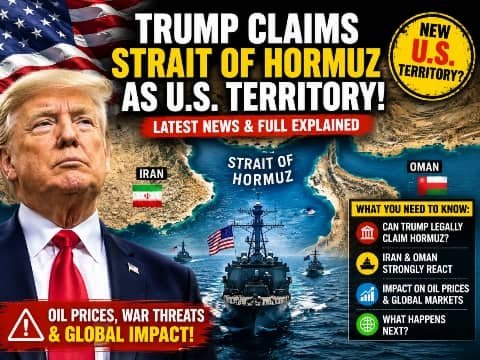
August 20, 2026 Update: Strait of Hormuz Crisis Continues
The Strait of Hormuz shipping crisis remains unresolved as of August 20, 2026. President Donald Trump has intensified economic pressure on countries supporting Iran, while commercial traffic through the strategic waterway remains far below normal levels.
Shipping remains severely disrupted
Only a small number of commodity vessels are currently crossing the Strait of Hormuz. While Trump says the waterway is open, Iran maintains that it remains closed. The practical reality is that shipping remains highly uncertain, with operators facing security concerns, insurance risks and rapidly rising costs.
Oil prices rise
Brent crude has climbed above $92 per barrel, while U.S. crude has moved above $86, as traders continue to price in the possibility of prolonged disruption. Higher oil prices could eventually increase gasoline, transportation and energy costs.
U.S. military helps selected tankers
Reports indicate that U.S. forces are helping some oil tankers navigate the waterway, particularly at night, in an effort to keep limited energy supplies moving. However, overall shipping remains well below pre-crisis levels.
Shipping costs are surging
Tanker demand and charter rates have risen sharply as fewer shipowners are willing to accept the risks associated with Hormuz voyages. For shipping companies, the key question is no longer simply whether the strait is technically open, but whether it is safe, insurable and commercially viable.
Trump’s “U.S. territory” claim remains unresolved
There has been no confirmed legal transfer of sovereignty over the Strait of Hormuz to the United States. Trump’s “NEW U.S. Territory” declaration remains a major political and strategic claim rather than an internationally recognized change in territorial status.
Bottom line: As of August 20, Hormuz remains a major global shipping and energy risk. Limited tanker movements continue, but uncertainty over security, oil supplies, insurance and U.S.-Iran relations means the crisis could continue putting pressure on global oil prices and shipping costs.
August 19, 2026: Trump’s “New U.S. Territory” claim becomes a major international dispute
The latest development is the continuing fallout from Trump’s decision to publicly portray the Strait of Hormuz as U.S. territory.
On August 18, Trump shared a map labeling the waterway “NEW U.S. Territory.” The post followed his earlier declaration that the United States would make the Strait of Hormuz a U.S. territory after the conflict with Iran. Iran responded by rejecting the American territorial claim, while an Iranian government-linked social media account responded provocatively by labeling California as “new territory” of Iran. (Anadolu Ajansı)
The symbolism matters.
A president publicly describing foreign territory as U.S. territory is very different from saying that the U.S. Navy has temporarily established a military presence or is enforcing a maritime blockade. Trump’s wording therefore raises questions about whether Washington is merely describing de facto control or is proposing an actual territorial annexation.
So far, there has been no indication that a legally recognized transfer of sovereignty over the Strait of Hormuz has occurred.
The situation is also complicated by competing claims about whether the waterway is currently open.
Trump has maintained that the Strait of Hormuz is operational and safe and has said that there are no active mines blocking the route. Iran, meanwhile, says the strait remains closed until Washington meets its demands, including sanctions relief and other conditions. Reuters reported on August 18 that maritime traffic remained heavily disrupted despite Trump’s assertion that the waterway was open. (Reuters)
That disagreement is critical because freedom of navigation through the Strait of Hormuz is not the same thing as sovereignty over the strait.
August 18, 2026: Trump says there are no Iran talks as Hormuz tensions escalate
On August 18, Trump said that the United States was not engaged in talks with Iran and that no talks were scheduled.
His statement came amid conflicting signals from other officials and reports of diplomatic contacts. At the same time, Trump continued insisting that the Strait of Hormuz was open and secure.
Iran’s position remained fundamentally different.
Iranian officials said the strait would remain closed until the United States met conditions associated with the previous interim arrangement, including the lifting of sanctions, releasing frozen Iranian assets and ending military pressure. (Reuters)
This makes the Strait of Hormuz much more than a territorial dispute. It has become a bargaining chip in the wider U.S.-Iran conflict.
The waterway is one of the most important energy chokepoints in the world. Disruption there affects crude oil, petroleum products, liquefied natural gas, tanker insurance, shipping costs and ultimately gasoline prices.
The economic consequences are already being felt.
Oil prices have remained elevated as traders assess the possibility of prolonged disruption. Reuters reported that continued uncertainty surrounding Hormuz was contributing to elevated energy prices and broader economic concerns. (Reuters)
August 18, 2026: Oman becomes central to the Strait of Hormuz dispute
Another major development is the increasingly important role of Oman.
Oman controls territory on the southern side of the Strait of Hormuz and has historically played a diplomatic role between Iran and Western governments. In the current crisis, Oman has been involved in discussions with Iran over how maritime traffic could eventually be managed.
Trump has strongly criticized the idea of an Iran-Oman arrangement.
The Associated Press reported that Trump had threatened military action against Oman because of concerns over an emerging maritime agreement involving Iran and the management of the Strait of Hormuz. (AP News)
This is significant because Oman is not Iran.
The Strait of Hormuz is bordered by both Iran and Oman, meaning that any future arrangement concerning navigation, maritime security or traffic management cannot simply be treated as an issue between Washington and Tehran.
Oman’s involvement also demonstrates why Trump’s territorial proposal is so controversial. The United States is not the coastal state of the Strait of Hormuz.
August 17, 2026: Trump again floats making Hormuz U.S. territory
On August 17, Trump again discussed the possibility of turning the Strait of Hormuz into U.S. territory.
Trump pointed to the American naval presence and blockade as evidence that the United States already exercises effective control over the waterway. Axios reported that Trump said he favored formally declaring the strategically important strait U.S. territory. (Axios)
This was not the first time Trump had made the claim.
Instead, it represented an escalation of a position he had already expressed several days earlier.
The same day, Trump also threatened Oman if it interfered with U.S. objectives concerning Iran and the strait. The statements demonstrated how the Hormuz question was becoming intertwined with the wider diplomatic and military conflict.
August 16, 2026: Trump says the Strait could become U.S. territory “pretty soon”
Trump’s August 14 comments received additional attention over the following days.
He said that after the United States finished defeating Iran, he would declare the Strait of Hormuz a U.S. territory “pretty soon.” Trump also suggested that, because of the U.S. blockade, the United States effectively controlled who could pass through the waterway. (Al Jazeera)
This is the point at which Trump’s rhetoric moved beyond simply discussing military control.
There is a major difference between:
“The U.S. controls maritime traffic through a blockade.”
and:
“The Strait of Hormuz is U.S. territory.”
The first describes a military or operational situation.
The second is a claim of sovereignty.
International law does not generally recognize unilateral territorial acquisition simply because a country has military forces capable of controlling an area.
That distinction is one of the most important things to understand when evaluating headlines about Trump’s Hormuz proposal.
August 14, 2026: Trump first makes the U.S. territory declaration publicly
On August 14, Trump made his most direct public statement about turning the Strait of Hormuz into U.S. territory.
Speaking in New York, Trump said that after defeating Iran, the United States would declare the Hormuz Strait a territory of the United States.
He connected the statement to the American naval blockade and argued that the United States was effectively determining which ships could pass through the waterway. (Al Jazeera)
Trump’s statement immediately attracted international attention because of the strategic importance of the strait.
Iran rejected the idea.
The dispute therefore developed along two competing narratives:
- Trump’s position: U.S. military power has given Washington effective control over the waterway.
- Iran’s position: Hormuz remains within the sphere of Iranian sovereignty and regional control.
- Oman’s position: Oman is a coastal state and has a direct interest in maritime arrangements.
- International maritime-law position: Navigation rights and sovereignty are separate legal concepts.
This distinction is essential for understanding what Trump’s announcement actually does and does not accomplish.
Why Is the Strait of Hormuz So Important?
The Strait of Hormuz connects the Persian Gulf with the Gulf of Oman and the Arabian Sea.
Its geography makes it one of the world’s most strategically important maritime chokepoints.
Large quantities of crude oil, petroleum products and natural gas normally pass through the waterway. Any prolonged disruption can therefore affect global energy markets.
The strait’s importance has made it a recurring source of tension between Iran, the United States and Gulf countries.
The International Maritime Organization has also highlighted the dangers created by attacks on commercial shipping in the region, including the risk of pollution from missiles, drones, fires and explosions involving ships carrying oil and hazardous materials. (International Maritime Organization)
The IMO has separately been involved in maritime contingency planning because of the large number of seafarers and vessels affected by the regional crisis. (International Maritime Organization)
In other words, Hormuz is not simply a line on a map.
It is a critical part of the global energy and shipping system.
Is the Strait of Hormuz Actually U.S. Territory?
No, Trump’s statement does not by itself make the Strait of Hormuz U.S. territory.
This is perhaps the most important answer to the question.
A presidential statement or social-media post does not automatically transfer sovereignty over foreign territory to the United States.
The Strait of Hormuz lies between Iran and Oman. The United Nations’ maritime-law materials identify Oman in connection with the legal framework and charts governing the Strait of Hormuz and associated sea lanes. (United Nations)
International maritime law recognizes different maritime zones and navigation rights. A coastal state’s territorial sea can extend up to 12 nautical miles under the United Nations Convention on the Law of the Sea framework, while international navigation rights can apply to straits used for international navigation.
That means the legal status of the waterway is considerably more complicated than simply asking which country has the strongest navy in the area.
Military control can exist without sovereign title.
For example, if a country establishes a blockade and prevents or permits ships from passing, that does not automatically mean the country owns the underlying territory.
What Does “U.S. Control” Mean Compared With “U.S. Territory”?
These terms should not be treated as synonyms.
U.S. military control
This means American forces can physically influence or regulate activity in an area.
Operational control
This means a military force may determine which vessels can safely move through an area or enforce specific restrictions.
De facto control
This means a state effectively exercises power over an area even if its legal claim is disputed.
Sovereignty
Sovereignty is the legal authority of a state over territory.
Trump’s statements primarily describe control, but his proposed declaration concerns sovereignty.
That is why international-law experts and governments are treating the issue differently from a routine military deployment.
August 13, 2026: Iran says Hormuz remains under its control
On August 13, the dispute became even more direct.
Reuters reported that Iran and the United States were making competing claims about who controlled the Strait of Hormuz.
Iranian officials said the waterway was fully under Iranian control, contradicting Trump’s claim that the United States had “total control.” (Reuters)
This created an extraordinary situation in which two opposing governments were effectively claiming operational dominance over the same strategic maritime corridor.
The United States had established a naval blockade around Iranian ports, while Iran continued to assert authority over maritime passage.
For shipping companies, the practical question was not simply who was legally correct.
The practical question was:
Can a commercial vessel safely enter and leave the Persian Gulf?
That uncertainty is what makes the crisis so damaging to global shipping.
August 12, 2026: Trump says the U.S. has “total control” of Hormuz
Trump’s August 12 statement was an important precursor to his territorial declaration.
He said the United States had “total control” of the Strait of Hormuz and suggested that Washington would keep that control.
Trump described the American naval blockade as a “wall of steel.” (Reuters)
The statement indicated that Trump’s thinking was moving toward a long-term American military presence in the waterway.
It also raised the possibility that the United States would not simply seek to reopen shipping and then withdraw.
Instead, Trump appeared to be considering a lasting U.S. role in the strategic corridor.
That possibility helps explain why his later use of the phrase “U.S. territory” generated such intense international reaction.
The U.S. Naval Blockade and Why It Matters
The American blockade is central to Trump’s argument.
The U.S. administration has maintained that its naval forces can prevent Iranian shipping from using the maritime route while protecting navigation for other vessels.
Defense Secretary Pete Hegseth said the United States could maintain the naval blockade indefinitely by rotating forces in and out of the region, according to Reuters. (Reuters)
That statement demonstrates the scale of America’s military capability.
But military capability is not identical to territorial ownership.
A naval blockade can impose enormous practical control over maritime traffic without changing the legal sovereignty of the coastal states.
This is why the phrase “U.S. control of Strait of Hormuz” should not automatically be interpreted as “Strait of Hormuz is legally U.S. territory.”
Iran’s Position on the Strait of Hormuz
Iran considers control over Hormuz a major strategic asset.
During the conflict, Iranian officials have repeatedly said that vessels cannot simply pass through the strait without Iranian authorization.
Reuters reported that Iran’s military leadership has maintained that the waterway is under Iranian control and has rejected U.S. claims that normal passage has been restored. (Reuters)
Iran has also reportedly used the issue of Hormuz as leverage in negotiations over sanctions, military operations and the future of the conflict.
In March, Iranian officials were already demanding recognition of Iranian sovereignty over the Strait of Hormuz as part of potential war-ending arrangements. (The Business Standard)
This shows that the territorial dispute did not suddenly appear in August.
It has been developing for months.
The June 2026 U.S.-GCC Position on Freedom of Navigation
The issue also has a wider regional dimension.
In June, the United States and Gulf Cooperation Council emphasized the importance of reopening the Strait of Hormuz and called for free, unconditional and unrestricted navigation. (State Department)
That position is fundamentally different from a claim that the United States should own the waterway.
The Gulf states have a powerful economic interest in keeping Hormuz open because their economies and energy exports depend heavily on maritime access.
A prolonged blockade or territorial confrontation could affect Saudi Arabia, the United Arab Emirates, Qatar, Kuwait, Bahrain and Oman, as well as major Asian and European energy markets.
Why Oman Is So Important
Oman occupies a unique geographical and diplomatic position.
Unlike Iran, which lies on the northern side of the Strait of Hormuz, Oman controls territory on the southern side and has historically maintained diplomatic relationships with both Iran and Western governments.
That makes Oman a natural participant in any discussion about reopening the waterway.
Reports that Oman and Iran were discussing arrangements for managing maritime traffic therefore became highly significant.
Trump’s anger toward Oman’s negotiations illustrates how complicated the dispute has become.
The question is no longer simply:
“Can Iran reopen Hormuz?”
It is increasingly:
“Who should manage maritime security and navigation through Hormuz after the conflict?”
That could become one of the most difficult issues in any future U.S.-Iran settlement.
What International Law Says About Trump’s Hormuz Claim
The short version is straightforward:
A U.S. president cannot simply convert an internationally important waterway bordered by foreign states into U.S. sovereign territory by announcing it.
The legal status of the Strait of Hormuz involves the law of the sea, coastal-state rights and international navigation rights.
The United Nations Security Council has also addressed the crisis, emphasizing that navigational rights and freedoms through the Strait of Hormuz must be respected. (United Nations Press)
This is an important point.
The international legal framework is focused not only on which country controls the waterway, but also on the rights of vessels to navigate through an internationally important strait.
Therefore, the central legal debate is likely to involve:
- Territorial sovereignty
- Territorial seas
- Transit passage
- Freedom of navigation
- Blockades
- Use of force
- Rights of Iran and Oman as coastal states
- International security arrangements
Trump’s announcement does not erase these legal questions.
Could the United States Physically Take Control of Hormuz?
The answer is different if the question is military rather than legal.
The United States possesses enormous naval capabilities, including aircraft carriers, destroyers, submarines, surveillance aircraft and other military assets.
Recent developments demonstrate that Washington has been able to exert substantial military pressure in and around the waterway.
But permanently occupying or administering the Strait of Hormuz would be a completely different undertaking.
It could require:
- Long-term military deployments
- Protection of commercial shipping
- Mine-clearing operations
- Coastal surveillance
- Maritime law enforcement
- Diplomatic agreements
- Rules for commercial vessels
- Management of Iranian and Omani territorial waters
- International recognition
- Potential military confrontation with Iran and regional actors
The political and military costs could therefore be enormous.
What Happens to Oil Prices if Hormuz Remains Disrupted?
The energy-market consequences are potentially enormous.
The Strait of Hormuz is one of the world’s most important routes for oil and gas shipments.
When shipping through the strait becomes uncertain, traders generally price in a higher geopolitical risk premium.
That can push crude oil prices higher.
Recent reporting showed Brent crude trading around the low $90s amid continuing uncertainty surrounding the waterway. (The Wall Street Journal)
If disruption becomes prolonged, possible consequences include:
- Higher gasoline prices
- Higher diesel prices
- Increased airline fuel costs
- Higher transportation expenses
- More expensive petrochemicals
- Increased inflation pressure
- Higher shipping insurance premiums
- Greater volatility in energy stocks
- Pressure on global economic growth
Trump has acknowledged that Americans could face higher gasoline prices while the administration maintains pressure on Iran, arguing that the cost is justified by the goal of preventing Iran from obtaining a nuclear weapon. (Breitbart)
What Does This Mean for Gas Prices?
For American consumers, the most immediate concern is likely to be gasoline.
Crude oil is a major input into gasoline prices. When oil prices rise because of geopolitical risk, gasoline prices can eventually rise as well.
The effect is not necessarily immediate or one-to-one because gasoline prices also depend on refining capacity, inventories, transportation costs, seasonal demand and regional market conditions.
Still, a prolonged Strait of Hormuz crisis could put upward pressure on global crude prices.
That is why Trump’s statement is not merely a foreign-policy story.
It can become an energy-price story.
Why Shipping Companies Are Watching Hormuz Closely
Commercial shipping depends on predictability.
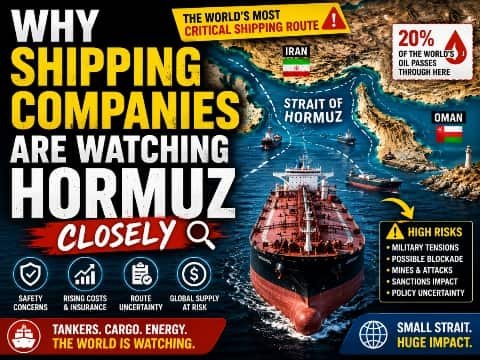
A tanker operator needs to know:
- Whether the route is open
- Which authority controls the route
- Whether the vessel requires permission
- Whether mines are present
- Whether missiles or drones threaten shipping
- Whether insurance coverage remains valid
- Whether the vessel could be detained
- Whether alternative routes are available
Even if the Strait is technically open, a sufficiently dangerous environment can make shipping economically impractical.
That is why the difference between “open” and “safe enough for commercial traffic” matters.
The current dispute between Trump and Iran has created precisely this type of uncertainty.
What Could Happen Next?
Several scenarios are possible.
Scenario 1: The territorial claim remains political rhetoric
Trump could continue using the phrase “U.S. territory” as leverage without attempting to establish formal sovereignty.
This would allow Washington to maintain pressure on Iran while avoiding the enormous consequences of attempting annexation.
Scenario 2: A new international maritime agreement emerges
Iran, Oman, the United States and other regional states could eventually negotiate a framework for reopening the waterway.
Such an agreement could involve navigation guarantees, security arrangements and monitoring.
Scenario 3: The U.S. maintains long-term military control
Washington could keep a substantial naval presence around Hormuz without formally claiming sovereignty.
This may be much more practical than attempting to make the strait a U.S. territory.
Scenario 4: The confrontation escalates
If Iran rejects American demands and Washington attempts to enforce permanent control, the conflict could become even more dangerous.
That could increase the risk to commercial ships, regional military bases and energy infrastructure.
Scenario 5: A broader U.S.-Iran settlement
The most comprehensive solution would involve a wider diplomatic agreement covering nuclear issues, sanctions, military operations and maritime navigation.
The problem is that as of August 19, there is no clear breakthrough.
Latest Trump Strait of Hormuz News: Key Takeaways
As of August 19, 2026, the most important facts are:
Trump has publicly proposed making the Strait of Hormuz U.S. territory.
He has described the United States as having total or effective control of the waterway through its naval presence.
On August 18, he shared a map labeling the strait “NEW U.S. Territory.” (Anadolu Ajansı)
Iran rejects the American claim and continues asserting control over the waterway. (Reuters)
Oman has become a major player because it borders the southern side of the strait and is involved in discussions concerning maritime management. (AP News)
U.S.-Iran diplomatic efforts remain uncertain, with Trump saying on August 18 that no talks were currently taking place or scheduled. (Reuters)
Shipping through Hormuz remains severely disrupted, despite Trump’s claim that the waterway is open and safe. (Reuters)
Oil prices remain highly sensitive to developments in the region. (The Wall Street Journal)
Most importantly, Trump’s statement should not be confused with a completed legal transfer of sovereignty.
The United States may exercise substantial military and operational control, but that does not by itself make the Strait of Hormuz legally American territory.
Final Analysis: Is Trump’s Hormuz Claim Real or Just a Threat?
Trump’s Strait of Hormuz statement is real as a political and strategic declaration, but it is not equivalent to an internationally recognized transfer of territory.
The president has clearly signaled that Washington wants to maintain a powerful role in the waterway and may be considering a permanent American presence. His language about declaring Hormuz U.S. territory represents an escalation from earlier statements about naval control.
Yet the legal and diplomatic obstacles are enormous.
Iran rejects the claim. Oman has its own interests as a coastal state. Gulf countries need secure navigation but may not necessarily support American territorial annexation. International maritime law provides a framework for coastal-state rights and navigation through strategically important straits. The United Nations has explicitly emphasized navigational rights and freedoms through Hormuz. (United Nations Press)
Therefore, the most accurate way to describe the situation is:
Donald Trump has proposed that the United States should claim the Strait of Hormuz as U.S. territory, and he argues that American military power already gives Washington effective control over the waterway. But the Strait of Hormuz has not thereby become legally recognized U.S. territory.
The bigger story is what happens after the declaration.
If Trump uses the proposal as negotiating leverage, it could become part of a broader U.S.-Iran settlement. If Washington attempts to physically impose a permanent territorial claim, the consequences could be dramatically more serious.
For now, the Strait of Hormuz remains at the intersection of U.S.-Iran tensions, global oil prices, international maritime law, freedom of navigation, Middle East security and global shipping.
And with the conflict approaching its six-month mark, the question is no longer simply whether Hormuz will reopen.
The increasingly important question is who will control, secure and regulate the world’s most strategically important oil chokepoint when the current conflict finally ends. (Axios)
Frequently Asked Questions About Trump and the Strait of Hormuz
- Is the Strait of Hormuz now U.S. territory?
No. Trump’s declaration and social-media post do not, by themselves, create internationally recognized U.S. sovereignty over the Strait of Hormuz. The waterway is bordered by Iran and Oman and is subject to international maritime-law principles.
- What did Trump say about the Strait of Hormuz?
Trump said the United States would declare the Strait of Hormuz a U.S. territory after defeating Iran. He also said the United States effectively controls the waterway because of its naval blockade. (Al Jazeera)
- When did Trump call Hormuz “new U.S. territory”?
Trump posted a map labeling the Strait of Hormuz “NEW U.S. Territory” on August 18, 2026. (Anadolu Ajansı)
- Does the U.S. control the Strait of Hormuz?
The United States has significant military and operational influence over maritime traffic because of its naval deployment and blockade. But military control is not the same as legal sovereignty.
- Why is the Strait of Hormuz important?
It is a critical maritime chokepoint connecting the Persian Gulf with the Gulf of Oman and the wider Indian Ocean. Major oil and gas shipments normally pass through the region, making disruption a major global economic risk.
- What does Iran say about Hormuz?
Iran rejects Trump’s territorial claim and has maintained that the waterway remains under Iranian control. Tehran has also demanded conditions relating to sanctions, military operations and frozen assets before agreeing to a broader reopening. (Reuters)
- What role does Oman play?
Oman borders the southern side of the Strait of Hormuz and has historically acted as a diplomatic intermediary between Iran and Western governments. Its discussions with Iran over maritime management have become a major point of contention with Washington. (AP News)
- Will Trump’s Hormuz claim increase oil prices?
It could. Any prolonged uncertainty about shipping through the Strait of Hormuz can increase the geopolitical risk premium on crude oil. Recent market reporting has already linked continuing Hormuz tensions with elevated oil prices. (The Wall Street Journal)
- Could Trump legally annex the Strait of Hormuz?
A unilateral presidential announcement cannot simply convert foreign maritime territory into U.S. territory. Any genuine territorial change would face major questions involving international law, the rights of Iran and Oman, U.S. constitutional authority, international recognition and the use of force.
1 thought on “Trump’s Strait of Hormuz U.S. Territory Claim: Latest News, Timeline, Legal Status and What It Means”