Carbon is one of the most versatile elements on Earth. It forms everything from the graphite in your pencil to the diamonds in fine jewelry. Yet among all the fascinating forms of carbon, one stands out as both scientifically revolutionary and visually striking: the buckyball.

If you’ve ever wondered, “What is a buckyball?”, you’re not alone. This remarkable molecule transformed the field of nanotechnology and opened doors to innovations in medicine, electronics, renewable energy, and materials science. Since its discovery, the buckyball has become one of the most studied nanomaterials in the world.
Unlike ordinary carbon structures, a buckyball consists of 60 carbon atoms arranged in a hollow sphere, resembling a soccer ball. Scientists refer to it as Buckminsterfullerene or simply C60 fullerene. Its extraordinary geometry gives it exceptional strength, stability, and unique chemical behavior.
Today, researchers continue exploring how buckyballs can improve batteries, deliver targeted cancer treatments, develop lightweight aerospace materials, clean polluted water, and even contribute to future quantum technologies.
In this comprehensive guide, you’ll learn everything about buckyballs—from their discovery and molecular structure to their properties, applications, advantages, limitations, and future potential.
What Is a Buckyball?
A buckyball is a spherical molecule made entirely of carbon atoms. Scientifically known as Buckminsterfullerene (C60), it belongs to a family of carbon molecules called fullerenes.
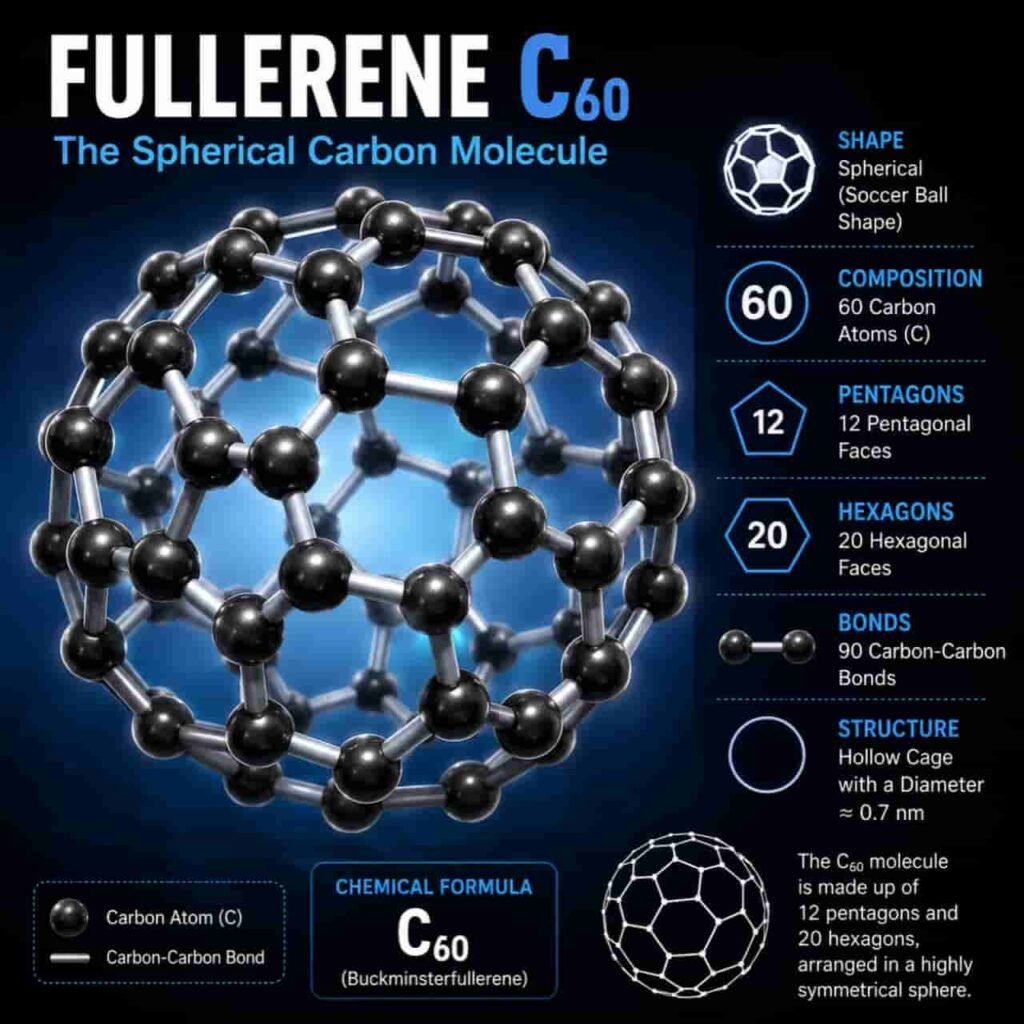
The molecule contains:
- 60 carbon atoms
- 90 carbon-carbon bonds
- A hollow spherical shape
- 12 pentagonal faces
- 20 hexagonal faces
This arrangement is identical to the pattern found on a traditional soccer ball.
Unlike graphite, where carbon atoms form flat layers, or diamond, where atoms create a rigid three-dimensional crystal, buckyballs create a perfectly closed cage-like structure.
Because of this unique geometry, buckyballs are classified as carbon nanostructures and represent one of the most important discoveries in nanoscience.
Why Is It Called a Buckyball?
The name “buckyball” comes from the famous American architect Buckminster Fuller.
Fuller became well known for designing geodesic domes, which use interconnected triangles to create lightweight yet incredibly strong structures.
Scientists noticed that the newly discovered carbon molecule had a geometry remarkably similar to Fuller’s dome designs.
To honor him, they named the molecule Buckminsterfullerene.
Since the full scientific name is quite long, researchers and the public soon adopted the nickname buckyball.
Today, both names are commonly used in chemistry, physics, and nanotechnology.
History of the Buckyball Discovery
The discovery of the buckyball is considered one of the greatest breakthroughs in modern chemistry.
Before 1985, scientists believed carbon mainly existed in three forms:
- Diamond
- Graphite
- Amorphous carbon
Everything changed during experiments designed to simulate the chemistry occurring in outer space.
Researchers vaporized graphite using powerful lasers and analyzed the resulting carbon clusters.
Among many different molecular sizes, one cluster repeatedly appeared with exactly 60 carbon atoms.
This unusual stability intrigued scientists.
Further investigation revealed that these atoms naturally arranged themselves into a perfectly symmetrical hollow sphere.
The discovery was made by:
- Harold Kroto
- Richard Smalley
- Robert Curl
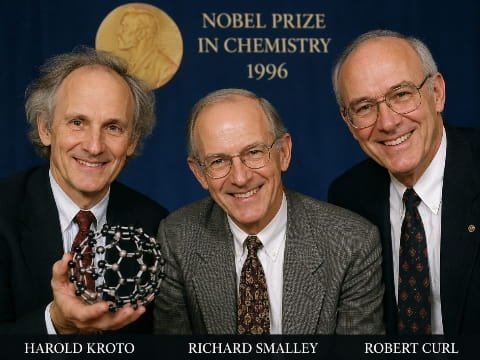
Their groundbreaking work introduced an entirely new family of carbon molecules known as fullerenes.
Because of this achievement, the three scientists received the 1996 Nobel Prize in Chemistry.
Their discovery also helped launch the modern era of nanotechnology.
Understanding the Molecular Structure of a Buckyball
The buckyball is famous because of its remarkable molecular architecture.
Imagine a soccer ball.
Every black pentagon and white hexagon represents groups of carbon atoms connected through strong covalent bonds.
Specifically, a C60 molecule contains:
- 12 pentagons
- 20 hexagons
- 60 carbon atoms
- 90 chemical bonds
Each carbon atom bonds with three neighboring atoms.
This bonding pattern creates:
- High symmetry
- Excellent mechanical strength
- Outstanding molecular stability
The molecule is hollow inside, making it capable of trapping other atoms or molecules within its cage.
Scientists call this property encapsulation, and it is one of the reasons buckyballs have attracted so much attention in medicine and nanotechnology.
Chemical Formula of Buckyball
The chemical formula is:
C60
This simply means the molecule contains sixty carbon atoms.
Unlike most molecules, C60 has:
- No hydrogen
- No oxygen
- No nitrogen
It is composed entirely of pure carbon.
This makes it one of the purest naturally occurring molecular carbon structures ever discovered.
Physical Properties of Buckyballs
Buckyballs possess a unique combination of physical characteristics rarely found in other materials.
Some important properties include:
Perfect Symmetry
The C60 molecule is among the most symmetrical molecules known in chemistry.
Its balanced shape contributes to remarkable stability.
Lightweight
Since it consists only of carbon atoms arranged in a hollow shell, the molecule remains extremely light.
High Strength
Although tiny, buckyballs can withstand enormous pressure due to their interconnected carbon bonds.
Elasticity
Under certain conditions, buckyballs can compress and return to their original shape.
This behavior has earned them comparisons to molecular springs.
Thermal Stability
Buckyballs remain stable across a broad range of temperatures.
This makes them useful in advanced industrial applications.
Chemical Properties of Buckminsterfullerene
Chemically, buckyballs behave differently from other forms of carbon.
Their curved surface creates areas of higher chemical reactivity.
Important chemical properties include:
- Ability to accept electrons
- Excellent electron transport
- High oxidation resistance
- Ability to form compounds with metals
- Capability to bond with polymers
- Compatibility with numerous organic molecules
These characteristics make C60 an attractive material for electronics and solar energy research.
How Are Buckyballs Made?
Scientists use several methods to produce buckyballs.
1. Laser Vaporization
One of the earliest techniques involves firing powerful laser pulses at graphite.
The intense heat vaporizes carbon atoms.
As the vapor cools, carbon atoms naturally assemble into fullerene molecules.
2. Electric Arc Discharge
This method places two graphite electrodes close together.
A strong electric current generates extremely high temperatures.
Carbon evaporates into a plasma and eventually cools into fullerene molecules.
This remains one of the most common laboratory production methods.
3. Combustion Synthesis
Researchers discovered that certain controlled flames naturally generate fullerenes.
This method is less expensive and suitable for larger-scale production.
4. Plasma Techniques
Industrial laboratories often use plasma reactors to manufacture fullerene materials with improved purity.
Advanced purification methods separate C60 from other fullerene molecules such as C70.
Different Types of Fullerenes
Although C60 is the most famous, it belongs to a larger family called fullerenes.
Other common examples include:
C70
Contains 70 carbon atoms.
It has a slightly elongated shape rather than a perfect sphere.
C76
A more complex fullerene used primarily in advanced materials research.
C84
Known for interesting electrical and magnetic behavior.
Giant Fullerenes
Scientists have synthesized molecules containing hundreds of carbon atoms, expanding the possibilities for nanotechnology and materials science.
Why Are Buckyballs Important in Nanotechnology?
The buckyball marked the beginning of a new era in nanotechnology because it demonstrated that carbon atoms could self-assemble into stable nanoscale structures with extraordinary properties.
Its discovery inspired research into:
- Carbon nanotubes
- Graphene
- Quantum dots
- Molecular electronics
- Nano-sized drug delivery systems
- Advanced composite materials
Today, these technologies influence industries ranging from healthcare to aerospace and renewable energy.
Applications of Buckyballs in Modern Science and Technology
Since their discovery, buckyballs have become one of the most exciting materials in nanotechnology. Their unique spherical structure, exceptional strength, and unusual electronic properties make them useful in many scientific fields. Although many applications are still being refined through research, buckyballs are already influencing medicine, renewable energy, electronics, aerospace engineering, and environmental science.
Let’s explore how this remarkable carbon molecule is changing the world.
1. Buckyballs in Medicine
One of the most promising areas of buckyball research is healthcare. Scientists believe that the tiny size and hollow cage-like structure of C60 fullerenes could revolutionize the way medicines are delivered inside the human body.
Targeted Drug Delivery
Traditional medications often travel throughout the body, affecting both healthy and diseased tissues. Buckyballs can act as microscopic carriers that transport drugs directly to the affected area.
Potential benefits include:
- More precise treatment
- Reduced side effects
- Lower medication doses
- Improved drug effectiveness
Researchers are studying how buckyballs can carry chemotherapy drugs directly to cancer cells while minimizing damage to healthy tissue.
Cancer Research
Although buckyballs are not currently approved as cancer treatments, laboratory studies suggest they may support future cancer therapies.
Scientists are investigating whether modified fullerene molecules can:
- Deliver anticancer drugs
- Improve imaging of tumors
- Generate reactive oxygen species that destroy cancer cells during photodynamic therapy
More clinical research is needed before these applications become widely available.
Medical Imaging
Buckyballs may also improve diagnostic imaging.
Researchers are experimenting with fullerene molecules combined with contrast agents for:
- MRI scans
- Molecular imaging
- Disease detection
- Early-stage cancer diagnosis
Their small size allows them to travel through tiny blood vessels that larger particles cannot access.
Antioxidant Properties
Several laboratory studies indicate that buckyballs may function as powerful free radical scavengers.
Free radicals contribute to:
- Aging
- Inflammation
- Cellular damage
- Certain chronic diseases
Because C60 molecules can interact with multiple free radicals simultaneously, scientists continue exploring their potential as advanced antioxidants.
However, more human studies are necessary to confirm their long-term safety and effectiveness.
2. Buckyballs in Electronics
Electronics is another field where buckyballs have attracted significant attention.
Their ability to conduct and accept electrons makes them valuable for next-generation electronic devices.
Potential applications include:
- Organic semiconductors
- Flexible electronic displays
- Molecular transistors
- Nanoelectronic circuits
- Conductive coatings
Researchers believe fullerene-based electronics could become smaller, faster, and more energy-efficient than many conventional technologies.
3. Buckyballs in Solar Cells
Renewable energy technologies often rely on materials that efficiently transport electrical charges.
Buckyballs excel in this role.
In many organic solar cells, fullerene derivatives serve as electron acceptors, helping convert sunlight into electricity more efficiently.
Benefits include:
- Improved energy conversion
- Lightweight solar panels
- Flexible photovoltaic materials
- Lower manufacturing costs
Although newer materials are also being explored, fullerene-based compounds remain important in photovoltaic research.
4. Batteries and Energy Storage
Modern batteries require materials that transfer electrons quickly while maintaining stability.
Scientists are investigating buckyballs for use in:
- Lithium-ion batteries
- Sodium-ion batteries
- Supercapacitors
- Hydrogen storage systems
Possible advantages include:
- Faster charging
- Higher energy density
- Longer battery life
- Better thermal stability
If ongoing research succeeds, future electric vehicles and portable electronics may benefit from fullerene-enhanced battery technology.
5. Environmental Applications
Environmental scientists are exploring buckyballs as tools for pollution control and water purification.
Potential uses include:
Water Filtration
Modified fullerene materials may help remove:
- Heavy metals
- Organic pollutants
- Industrial chemicals
- Harmful microorganisms
Their large surface area allows them to interact efficiently with contaminants.
Air Purification
Researchers are testing fullerene-based materials capable of capturing airborne pollutants and improving air quality in industrial settings.
Environmental Sensors
Buckyballs are highly sensitive to chemical changes.
This makes them useful for developing nanosensors capable of detecting:
- Toxic gases
- Water contamination
- Hazardous chemicals
- Environmental pollutants
6. Aerospace Engineering
Weight reduction is a major goal in aerospace engineering.
Because buckyballs are incredibly light yet mechanically strong, engineers are studying them for advanced composite materials.
Possible applications include:
- Aircraft components
- Spacecraft materials
- Satellite equipment
- Protective coatings
Although carbon nanotubes currently receive more commercial attention, fullerene-based materials continue to contribute to advanced aerospace research.
7. Advanced Materials
Manufacturers often combine buckyballs with polymers to improve material performance.
These composites may offer:
- Greater durability
- Higher impact resistance
- Improved heat resistance
- Enhanced electrical conductivity
- Better flexibility
Industries exploring these materials include:
- Automotive
- Construction
- Sporting goods
- Consumer electronics
8. Lubricants
One unusual property of buckyballs is their nearly spherical shape.
Scientists compare them to microscopic ball bearings.
When incorporated into lubricants, they may help reduce:
- Friction
- Mechanical wear
- Heat generation
Potential applications include:
- Industrial machinery
- Precision instruments
- Automotive engines
9. Sensors
Buckyballs respond to even tiny chemical changes.
This sensitivity allows researchers to develop highly accurate sensors capable of detecting:
- Explosive materials
- Biological molecules
- Disease biomarkers
- Air pollution
- Food contamination
Nano-scale sensors based on fullerene technology may become increasingly important in healthcare and environmental monitoring.
10. Quantum Computing
Quantum computing represents one of the most advanced areas of modern science.
Researchers are investigating fullerene molecules because their electron behavior may be useful in:
- Quantum bits (qubits)
- Spintronics
- Molecular computing
- Quantum information storage
Although still experimental, buckyballs could contribute to future quantum technologies.
Advantages of Buckyballs
The popularity of buckyballs stems from their remarkable combination of physical and chemical properties.
Some major advantages include:
Exceptional Strength
Despite their tiny size, buckyballs possess extraordinary structural stability.
Lightweight Structure
Being composed entirely of carbon atoms, they add minimal weight to advanced materials.
High Chemical Stability
They remain stable under many environmental conditions.
Excellent Electron Transport
Their electronic properties make them attractive for semiconductors, solar cells, and batteries.
Large Surface Area
The spherical shape provides extensive surface interaction for catalysts and drug delivery systems.
Ability to Encapsulate Other Molecules
The hollow interior allows scientists to trap atoms or molecules inside the carbon cage.
This unique feature opens opportunities in medicine and nanotechnology.
Limitations of Buckyballs
Although buckyballs offer tremendous potential, they also present several challenges.
High Production Costs
Manufacturing high-purity fullerenes remains relatively expensive compared to conventional materials.
Limited Commercial Availability
Many applications remain in research rather than mass production.
Safety Concerns
Scientists continue studying how fullerene nanoparticles interact with living organisms.
Questions remain regarding:
- Long-term toxicity
- Environmental impact
- Biodegradation
- Occupational exposure
Current evidence suggests that safety depends on factors such as particle size, surface modification, dose, and route of exposure. Continued research is essential before widespread medical use.
Difficult Manufacturing Process
Producing large quantities of pure C60 requires sophisticated equipment and purification techniques.
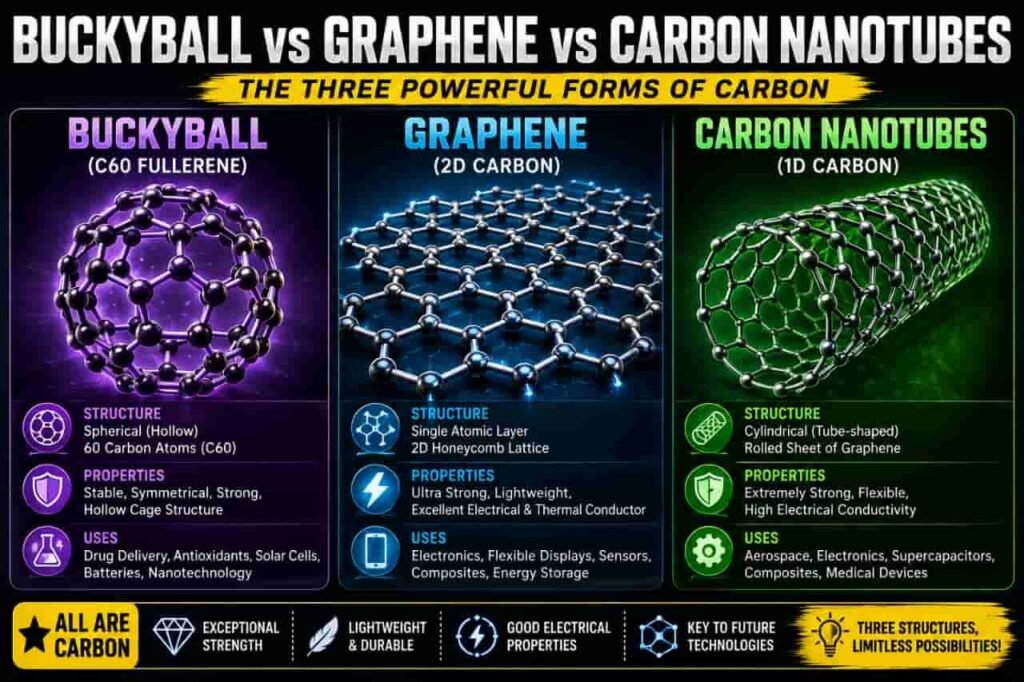
Buckyball vs Other Carbon Allotropes
| Property | Buckyball (C60) | Graphene | Carbon Nanotubes | Diamond | Graphite |
|---|---|---|---|---|---|
| Shape | Hollow sphere | Flat sheet | Cylindrical tube | 3D crystal | Layered sheets |
| Carbon Atoms | 60 | Unlimited | Millions | Continuous | Continuous |
| Strength | Very high | Extremely high | Extremely high | Extremely high | Moderate |
| Electrical Conductivity | Good | Excellent | Excellent | Poor | Good |
| Flexibility | Moderate | Excellent | Excellent | Very low | High |
| Main Uses | Medicine, nanotechnology | Electronics | Composites | Cutting tools | Batteries, pencils |
Current Research Trends
Scientists around the world continue investigating new ways to use buckyballs. Current research focuses on:
- Artificial intelligence-assisted materials discovery
- Next-generation solar cells
- Hydrogen fuel storage
- Flexible electronics
- Wearable medical devices
- Advanced cancer therapies
- Smart drug delivery
- Quantum technologies
- Sustainable nanomaterials
- High-performance batteries
As manufacturing becomes more affordable, fullerene-based technologies may move from laboratories into everyday products.
Are Buckyballs Safe?
One of the most common questions people ask is whether buckyballs are safe for humans and the environment. The answer is not entirely straightforward.
Researchers have been studying the safety of Buckminsterfullerene (C60) for decades. The findings suggest that the effects of buckyballs depend on several factors, including their size, concentration, surface modifications, and how they enter the body.
Human Health
Laboratory studies indicate that specially modified buckyballs may be useful in medicine, particularly for drug delivery and diagnostic imaging. However, inhaling or ingesting certain nanoparticle forms in large quantities could potentially pose health risks.
Scientists continue to investigate:
- Long-term exposure effects
- Toxicity at different doses
- Interaction with human cells
- Metabolism and elimination
- Immune system responses
As of today, there is no widespread consumer use of pure buckyballs in medicine, and additional clinical research is needed before they become common in healthcare.
Environmental Impact
Because buckyballs are nanomaterials, researchers are also examining how they interact with ecosystems.
Current studies focus on:
- Water contamination
- Soil behavior
- Effects on aquatic organisms
- Environmental persistence
- Biodegradation
Understanding these factors will help ensure that future fullerene-based technologies are developed responsibly.
Interesting Facts About Buckyballs
Here are some fascinating facts that make buckyballs one of the most remarkable molecules ever discovered.
1. They Resemble a Soccer Ball
The C60 molecule has exactly the same geometric pattern as a traditional soccer ball, consisting of 12 pentagons and 20 hexagons.
2. They Are Made Entirely of Carbon
Unlike many complex molecules, buckyballs contain only carbon atoms.
3. They Helped Launch Nanotechnology
The discovery of fullerenes accelerated research into carbon nanotubes, graphene, and numerous nanomaterials.
4. Nobel Prize-Winning Discovery
The discovery of Buckminsterfullerene earned the 1996 Nobel Prize in Chemistry.
5. They Exist in Space
Scientists have detected fullerene molecules in interstellar space, planetary nebulae, and meteorites, suggesting they naturally form under certain cosmic conditions.
6. Extremely Small
A single buckyball measures approximately 0.7 nanometers in diameter.
Millions of buckyballs could fit across the width of a human hair.
7. They Can Trap Other Atoms
The hollow carbon cage can encapsulate atoms or small molecules, creating specialized compounds known as endohedral fullerenes.
8. Strong Yet Lightweight
Their cage-like structure combines remarkable strength with an incredibly low weight.
9. Excellent Electron Acceptors
Buckyballs readily accept electrons, making them valuable in electronics and solar energy research.
10. Scientists Are Still Discovering New Uses
Every year, researchers publish hundreds of studies exploring fullerene applications in medicine, energy, environmental science, and advanced materials.
Frequently Asked Questions (FAQs)
What is a buckyball?
A buckyball is a spherical carbon molecule made of 60 carbon atoms (C60) arranged in a pattern similar to a soccer ball. It is also known as Buckminsterfullerene.
Why is it called a buckyball?
The molecule is named after architect Buckminster Fuller, whose geodesic dome designs resemble the molecule’s geometric structure.
What is the chemical formula of a buckyball?
The chemical formula is:
C60What are fullerenes?
Fullerenes are a family of hollow carbon molecules that include C60, C70, C76, C84, and many larger structures.
Is a buckyball the same as graphene?
No.
Graphene is a flat sheet of carbon atoms, while a buckyball is a hollow spherical carbon molecule.Are buckyballs naturally occurring?
Yes.
Scientists have identified fullerene molecules in meteorites, interstellar clouds, and planetary nebulae.What are buckyballs used for?
Researchers study buckyballs for applications in:
Medicine
Drug delivery
Solar cells
Batteries
Nanotechnology
Electronics
Sensors
Water purification
Advanced materialsAre buckyballs stronger than diamonds?
Not exactly.
Diamonds remain one of the hardest known natural materials, while buckyballs are valued for their flexibility, resilience, and nanoscale mechanical properties rather than bulk hardness.Can buckyballs conduct electricity?
Yes.
Their electronic properties make them useful in semiconductors, photovoltaics, and molecular electronics.Are buckyballs safe?
Current research suggests that safety depends on the form, concentration, and exposure route. More studies are needed to fully understand their long-term effects on humans and the environment.
What is the size of a buckyball?
A typical C60 molecule has a diameter of approximately 0.7 nanometers (nm).
Who discovered buckyballs?
Buckminsterfullerene was discovered in 1985 by Harold Kroto, Richard Smalley, and Robert Curl.
Why are buckyballs important?
They introduced scientists to an entirely new class of carbon materials and helped establish the field of modern nanotechnology.
Can buckyballs store hydrogen?
Researchers are investigating fullerene-based materials for hydrogen storage, but practical commercial solutions are still under development.
What industries use fullerene technology?
Research involving fullerene materials spans multiple industries, including:
Healthcare
Electronics
Aerospace
Renewable energy
Automotive
Environmental engineering
Materials science
Key Takeaways
- A buckyball is a spherical molecule composed of 60 carbon atoms (C60).
- It belongs to the fullerene family of carbon allotropes.
- Its structure resembles a soccer ball with 12 pentagons and 20 hexagons.
- The molecule was discovered in 1985 and recognized with the 1996 Nobel Prize in Chemistry.
- Buckyballs are important in nanotechnology, medicine, electronics, renewable energy, and advanced materials research.
- Scientists continue exploring their potential in drug delivery, solar cells, batteries, environmental cleanup, and quantum technologies.
- While highly promising, many applications remain under active investigation, and long-term safety studies are ongoing.
Conclusion
The discovery of the buckyball transformed our understanding of carbon and opened the door to countless innovations in nanoscience. What began as a surprising laboratory observation in 1985 has become one of the most influential breakthroughs in modern chemistry.
With its perfectly symmetrical C60 structure, exceptional stability, and versatile chemical properties, the buckyball continues to inspire research across medicine, electronics, renewable energy, aerospace, and environmental science. Although many practical applications are still being developed, its impact on science is already profound.
As researchers refine manufacturing techniques and deepen their understanding of fullerene behavior, buckyballs are likely to play an even greater role in future technologies. Whether improving energy storage, enabling smarter medical treatments, or contributing to next-generation materials, this remarkable carbon molecule demonstrates how discoveries at the nanoscale can shape the future.
Read Also: